
Last reviewed: October 4, 2026 by the NBI Clearance Online Editorial Team
An NBI clearance and a police clearance are two different certificates from two different agencies. The NBI clearance comes from the National Bureau of Investigation and checks NBI records nationwide; the national police clearance comes from the Philippine National Police (PNP). For work or visas abroad, the NBI clearance is almost always the one you need.
Here’s how they compare, and how to tell which one your employer, school or embassy actually wants.
We’re here to help you every step of the way. NBI Clearance Online is an independent guide, not the NBI or any government agency. Applications are made only through the official websites and offices named on this page.
NBI clearance vs police clearance at a glance
| NBI clearance | National police clearance | |
|---|---|---|
| Issued by | National Bureau of Investigation (NBI), under the Department of Justice | Philippine National Police (PNP) |
| Where to apply | Official NBI Clearance website (clearance.nbi.gov.ph), then an NBI branch | PNP National Police Clearance System (pnpclearance.ph), then a police station |
| Fee | ₱130 plus an e-payment charge | ₱150 base fee plus online charges (the PNP has proposed raising it to ₱200) |
| Validity | One year from the date of issue | Six months |
| Biometrics | Photo, fingerprints and signature at the NBI branch | Photo and fingerprints at the police station |
| Usually asked for | Jobs abroad, visas, immigration, government jobs, licensing | Some local jobs, barangay and local permits |
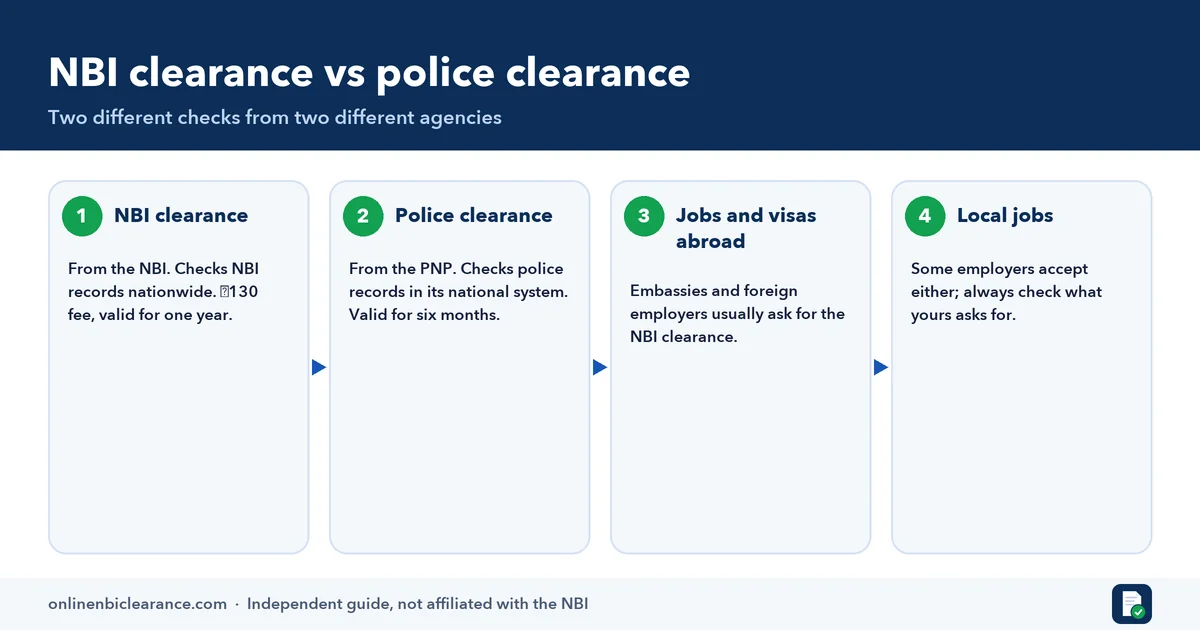
What each clearance checks
The NBI clearance is checked against the NBI’s criminal records, which the bureau describes as the national repository of criminal records. If your name matches a record, you get a HIT and a short verification before release.
The national police clearance is checked against the PNP’s records through its National Police Clearance System, which replaced older station-by-station clearances so that one police clearance now covers records across police stations nationwide.
Because they come from different agencies and databases, one doesn’t replace the other unless the office receiving it says so.
Which one do you need?
| Situation | Usually required |
|---|---|
| Working abroad (OFW) or a foreign employer | NBI clearance, often apostilled by the DFA |
| Visa, residency or immigration application | NBI clearance |
| Government job or PRC licensure exam | NBI clearance |
| Local private employer | Either, depending on the employer’s list |
| Barangay, business or local permits | Often the police clearance; check the office’s list |
When in doubt, ask the office for the exact document name on their requirements list. “NBI clearance” and “police clearance” aren’t interchangeable just because both mention clearance.
How to apply for each
NBI clearance: register on the official NBI Clearance website, book an NBI appointment, pay the ₱130 NBI clearance fee, then visit the branch with two valid IDs. With no HIT, it’s released the same day.
National police clearance: register on the PNP’s National Police Clearance System (pnpclearance.ph), choose a police station and schedule, pay online, then go to the station for your photo and fingerprints.
Can you get both?
Yes, and many job seekers do. They’re separate applications with separate fees. If you’re a first-time jobseeker with a barangay certification, RA 11261 makes both free once, including the free NBI clearance for first-time jobseekers.
FAQs about NBI vs police clearance
Is NBI clearance better than police clearance?
Neither is “better”; they’re different. For overseas work, visas and most government transactions, the NBI clearance is the one asked for.
Can I use a police clearance instead of an NBI clearance?
Only if the office says it accepts a police clearance. Embassies and foreign employers usually don’t.
Which is cheaper?
The NBI clearance fee is ₱130 plus an e-payment charge; the national police clearance starts at a ₱150 base fee plus online charges.
Which lasts longer?
The NBI clearance is valid for one year; the national police clearance is valid for six months.
Spotted something that changed?
Rules and fees can change. If anything here no longer matches what you saw, please let us know and we’ll check it. Every guide follows our editorial policy and is checked against official sources.