
Last reviewed: October 2, 2026 by the NBI Clearance Online Editorial Team
A HIT on your NBI clearance means your name matched, or closely resembled, a name in the NBI’s records, so your clearance needs manual verification before it can be released. It does not automatically mean you have a criminal record. Most HITs are namesakes: people who simply share a common name with someone who has a case.
If you get a HIT, you’ll be given a return date, usually after 5 to 10 working days, and there’s no extra fee. This guide explains why HITs happen, what the quality control interview involves, and how to get your clearance released as quickly as possible.
We’re here to help you every step of the way. NBI Clearance Online is an independent guide, not the NBI or a government agency. We can’t check whether you have a HIT or a record. Only the NBI can verify that, at your branch or through the official NBI Clearance website (clearance.nbi.gov.ph).
NBI clearance HIT at a glance
| Item | Details |
|---|---|
| What it means | Your name matched or resembled a name in NBI records and must be verified |
| Does it mean you have a record? | No, not by itself. Many HITs are namesakes |
| Release time | Usually 5–10 working days; you return on the scheduled date |
| Extra fee | None |
| Possible next step | A quality control interview to compare you with the derogatory record |
| If the record is yours | You may need court documents showing how the case ended before a clearance is issued |
On this page:
- What does HIT mean?
- Why you got a HIT
- What happens next
- The quality control interview
- How long it takes
- Documents that help
- If the record is yours
- FAQs
What does HIT mean on an NBI clearance?
During your branch visit, the NBI checks your name against its criminal database. The NBI describes itself as the national repository of criminal records in the Philippines, so the database includes cases from courts and law enforcement across the country.
There are two possible results:
- No HIT: nothing matches, and your clearance goes straight to printing. You usually get it the same day.
- With HIT: something in the records matches or resembles your name. You’re asked to return on a scheduled date, and your clearance is released only after the match is checked.
Why you got a HIT
The most common reasons are:
- A common name. Names like “Juan Dela Cruz”, “Maria Santos” or “Jose Reyes” are shared by thousands of people. If anyone with that name has a case, everyone with the same name may get a HIT.
- A similar name. The system can flag names that are close, not just identical, for example a different middle name or a spelling variation.
- A past case that has been resolved but still appears in the records until it’s matched with its final outcome.
- An actual pending case or warrant under your name.
What happens after a HIT, step by step
Based on the NBI’s Citizen’s Charter, the process goes like this:
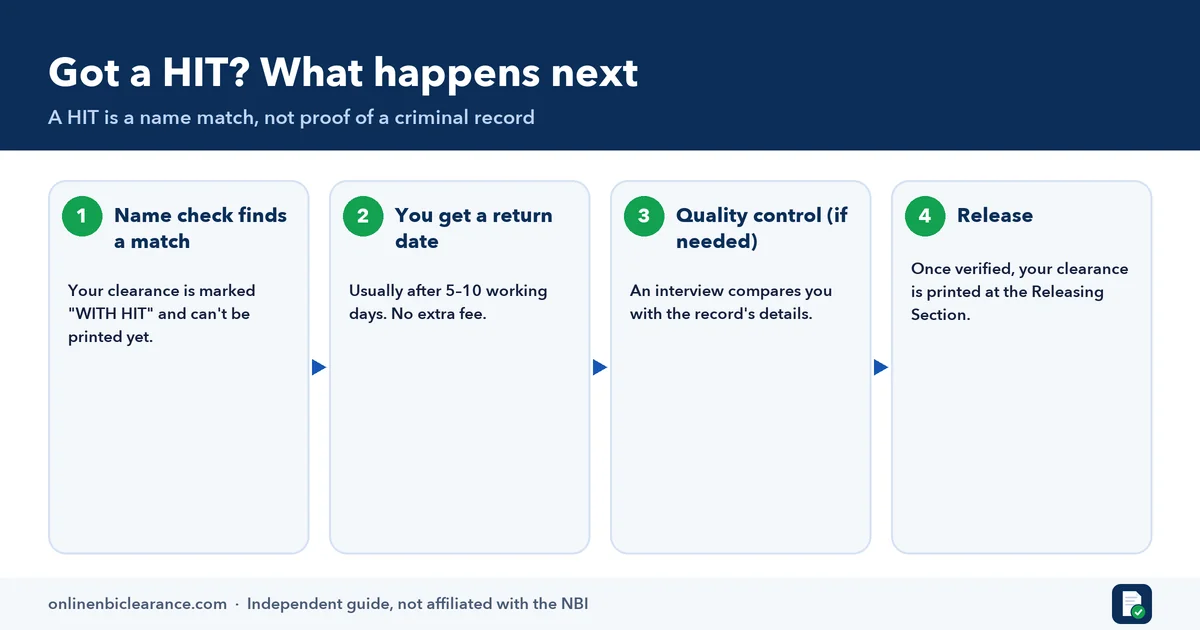
- Biometrics as usual. Your photo, fingerprints and signature are captured at the branch.
- Name check returns “WITH HIT”. Staff tell you that your clearance needs verification.
- You get a return date. Write it down or take a photo of the slip.
- Quality control (if needed). If your status says “For Quality Control”, you’ll be interviewed and verified against the derogatory record.
- Release. Once the NBI confirms the record isn’t yours, or is resolved, your clearance is printed and released at the Releasing Section.
The quality control interview
If your record needs a closer look, you’ll go to the Quality Control Section. The interviewer compares you with the details of the record: full name, birth date, birthplace, parents’ names and other identifying information.
To make it quick:
- Answer honestly and consistently.
- Bring your PSA birth certificate and your valid IDs so your details can be checked.
- If you already know about an old case under your name, bring the court documents (see below).
For true namesakes, the interview is often enough to show you’re a different person.
How long does a HIT take to clear?
Expect 5 to 10 working days from your branch visit. The NBI gives you the exact return date on the day. It can take longer if the record needs coordination with the court or agency that filed it, or if you need to bring documents.
Plan ahead: if you need your clearance for a job or visa deadline, apply at least two weeks early.
Documents that help clear a HIT
You don’t need any extra documents for a simple namesake HIT. But if a record is linked to you, these can help:
- PSA birth certificate, to prove your full name, birth date and parents
- Valid IDs showing your complete name, including middle name
- Court clearance or certification from the court that handled the case
- Order of dismissal or acquittal, with a certificate of finality if available
- Prosecutor’s resolution if the complaint was dismissed before reaching court
Bring originals and photocopies, and ask the NBI staff exactly which document they need for your record.
If the record really is yours
If the case is still pending or there is an active warrant, the NBI won’t issue a “no record” clearance. The NBI coordinates with the courts to verify such records and, where there is a valid warrant, may take the person into custody. If you know you have an unresolved case, talk to a lawyer or the Public Attorney’s Office before applying.
If the case was already dismissed, you were acquitted, or you served your sentence, bring the court documents that prove it. The NBI uses them to update or annotate the record so your clearance can be released.
Will you get a HIT again next time?
Possibly, especially if you have a common name. A few things help:
- Use your complete name, including your full middle name and suffix, every time you apply.
- Keep copies of any documents that cleared a previous HIT.
- If you qualify, getting a new clearance online or through eGovPH can be faster. Note that a HIT on an online application means you’ll need to appear at the NBI in person. See our NBI clearance renewal guide.
Common HIT problems and fixes
| Situation | What to do |
|---|---|
| Return date is after my job deadline | Ask your employer whether they will accept your HIT slip as proof that your clearance is being processed. Apply earlier next time. |
| I missed my return date | Go back to the same branch as soon as you can with your slip, reference number and IDs. |
| I get a HIT every year | Bring your PSA birth certificate and any documents that cleared earlier HITs to every visit. |
| Someone offers to “remove” my HIT for a fee | Refuse. Only the NBI can clear a HIT, and there’s no fee for it. |
| The record mentions a case I don’t know about | Ask the NBI for the case details, then get a certification from the court that handled it. |
FAQs about NBI HITs
Does a HIT mean I have a criminal record?
No. A HIT only means your name matched or resembled a name in NBI records. Most HITs turn out to be namesakes.
How many days does an NBI HIT take?
Usually 5 to 10 working days. The NBI gives you the exact return date at the branch.
Do I pay extra if I have a HIT?
No. There’s no additional fee for a HIT or for quality control.
Can someone else claim my clearance after a HIT?
Ask your branch when you get your return date. If you need to be interviewed for quality control, you’ll have to go in person.
Why do I get a HIT even with no record?
Because someone with the same or a similar name has a record. The NBI must check that it isn’t you before releasing your clearance.
Can I check if I have a HIT before applying?
No. The name check happens only during processing at the NBI. Apply early if you think your name is common.
What is “For Quality Control” on my NBI status?
It means your HIT needs an interview and verification at the Quality Control Section before your clearance can be released.
Spotted something that changed?
If your experience with a HIT was different from what’s described here, please tell us. It helps us keep this guide accurate. See how we verify our guides in our editorial policy.