
Last reviewed: October 2, 2026 by the NBI Clearance Online Editorial Team
If you’ll use your NBI clearance in another country, the receiving employer or immigration office will often ask for it to be apostilled. An apostille is a certificate from the Philippine Department of Foreign Affairs (DFA) that confirms your document is genuine, so it’s accepted in countries that are part of the Apostille Convention. The Philippines started issuing apostilles on May 14, 2019, replacing the old “red ribbon” authentication.
Below are the steps, the fees published by the DFA, and how to avoid a wasted trip.
We’re here to help you every step of the way. NBI Clearance Online is an independent guide, not the NBI, the DFA or a government agency. Apostille appointments are booked only through the DFA’s official apostille website (apostille.gov.ph). DFA procedures and fees can change, so confirm them there before you pay.
NBI clearance apostille at a glance
| Item | Details |
|---|---|
| Who issues it | The Department of Foreign Affairs (DFA), Office of Consular Affairs |
| Where to book | The DFA’s official apostille website (apostille.gov.ph) |
| Fee (per DFA) | ₱100 regular processing (about 5 working days) or ₱200 expedited (about 2 working days) |
| NBI clearance process | Since April 2025, the DFA asks you to upload a copy of your NBI clearance when booking and to pay the fee online |
| Walk-ins | Book an appointment first; the DFA processes apostille requests by appointment |
| Representative | Allowed with an authorization letter and a copy of the owner’s ID |
On this page:
- Do you need an apostille?
- How to get it apostilled
- Documents to bring
- If someone else submits it
- FAQs
Do you need an apostille?
You usually need one if:
- you’re applying for work, residency or a visa in a country that’s part of the Apostille Convention; and
- the employer, agency or immigration office specifically asks for an apostilled NBI clearance.
Some countries that aren’t part of the convention may ask for extra legalization by their embassy. Others accept the clearance without an apostille. Ask the receiving office first, so you don’t pay for something you don’t need.
How to get your NBI clearance apostilled
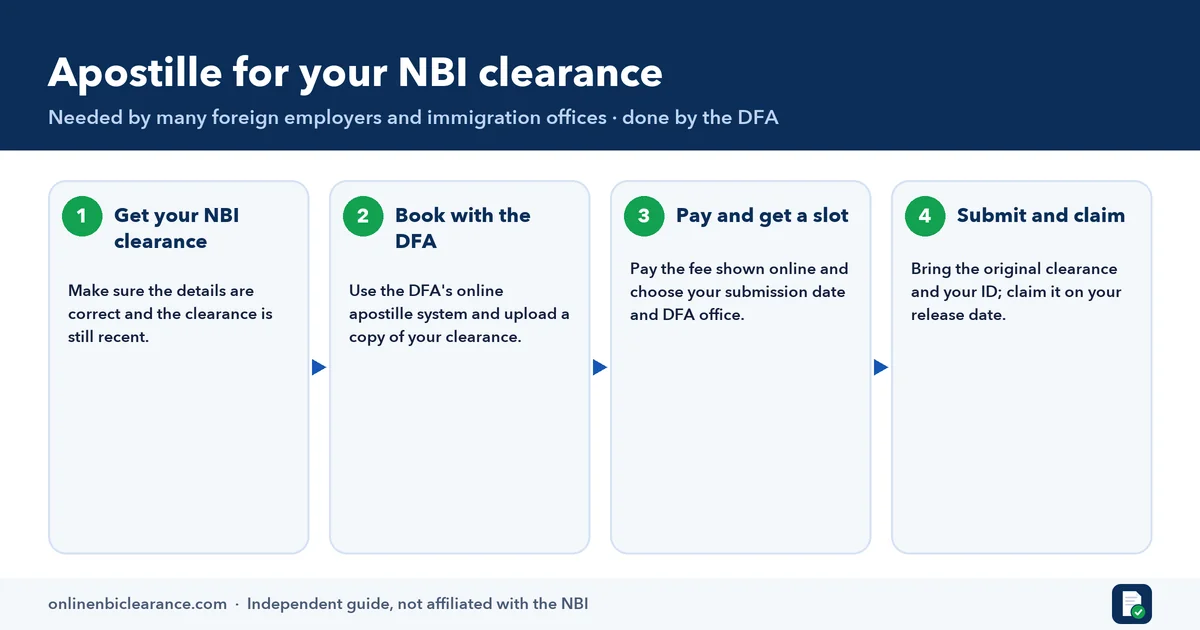
- Get your NBI clearance first. Check that every detail is correct and that it’s recent enough for the receiving office. Many want one issued within the last six months; see how long an NBI clearance is valid.
- Go to the DFA’s apostille website (apostille.gov.ph) and create an account.
- Upload a clear copy of your NBI clearance when asked. The DFA introduced this upload step for NBI clearances in April 2025.
- Choose regular or expedited processing and pay online. The DFA’s published fees are ₱100 for regular processing and ₱200 for expedited.
- Pick your DFA office, date and time for submitting the original.
- Submit the original clearance on your appointment date with your valid ID and the printed appointment details.
- Claim the apostilled clearance on your release date, or use the DFA’s delivery option if offered.
Documents to bring to the DFA
- The original NBI clearance (not a photocopy)
- Your appointment confirmation or transaction slip
- A valid government-issued ID and a photocopy
- Proof of payment, if you paid online
If someone else will submit it
A representative can usually submit and claim the apostille for you. They should bring:
- an authorization letter signed by you;
- a photocopy of your valid ID; and
- their own valid ID and a photocopy.
This is useful if you’re already overseas. For getting the clearance itself from outside the Philippines, see our guide on getting an NBI clearance abroad.
Common apostille problems
| Problem | What to do |
|---|---|
| Clearance too old for the receiving office | Get a new clearance first, then apostille the new one. |
| Wrong details on the clearance | Fix them with the NBI before you book the DFA appointment. |
| Showing up without an appointment | Book on the DFA’s apostille website; walk-ins aren’t processed. |
| Representative missing documents | Bring the signed authorization letter and copies of both IDs. |
| Paid a fixer for a fast apostille | Use only the DFA’s official system; fixers can’t speed it up. |
FAQs about NBI clearance apostille
How much is the apostille for an NBI clearance?
The DFA lists ₱100 for regular processing and ₱200 for expedited processing per document. Confirm the current fee on the DFA’s apostille website before paying.
How long does the apostille take?
According to the DFA, about five working days for regular processing and about two working days for expedited.
Can I walk in at the DFA without an appointment?
No. Book online on the DFA’s apostille website first.
Does the apostille expire?
The apostille itself doesn’t expire, but the NBI clearance underneath is valid for one year, and many countries want a recent one.
Can I apostille a photocopy of my NBI clearance?
No. You’ll upload a copy when booking, but you must submit the original clearance.
Do I still need the red ribbon?
No. Apostilles replaced red ribbon authentication in the Philippines on May 14, 2019, for countries that are part of the Apostille Convention.
Spotted something that changed?
DFA apostille procedures and fees change from time to time. If anything here doesn’t match what you see on the DFA’s website, please let us know so we can update this guide. See how we verify our guides in our editorial policy.